Recoil Starter Repair: Pull Cord, Spring and Pawl Replacement
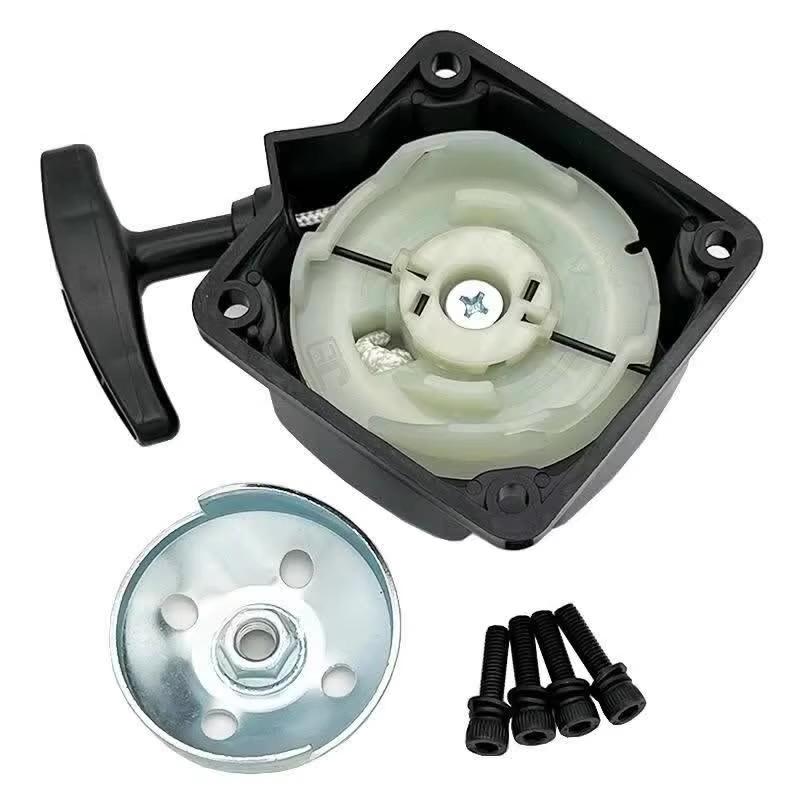
The recoil starter is the most handled part on any pull-start machine, and it shows: frayed cords, springs that no longer rewind, and pawls that slip instead of gripping the cup. The good news is that nearly every recoil fault is mechanical, visible, and cheap to fix. This guide covers the three common failures and when a complete replacement assembly is the smarter buy.
How the Recoil Starter Works
Pulling the cord rotates a pulley; pawls on the pulley swing out and grip the starter cup on the flywheel, turning the engine over. Release the cord and a flat spiral spring rewinds the pulley. Four parts do all the work — cord, pulley, spring, pawls — and each fails in its own recognisable way.
Failure 1: The Pull Cord
A frayed or snapped cord is the most common failure and the easiest fix. Remove the starter cover (usually three or four screws), unwind the remaining cord, and thread the new one through the pulley and housing eyelet with a figure-eight or double overhand knot at each end. Pre-tension by winding the pulley a turn or two against the spring before letting the cord rewind — the handle should sit snug against the housing without the spring being at its limit. Match the cord diameter to the original; too thick and it binds in the pulley groove.
Failure 2: The Rewind Spring
When the cord hangs loose and refuses to rewind, the spring has lost tension or snapped at its anchor. Springs can be refitted, but they are under tension and awkward to seat — wear gloves and eye protection, and wind the spring into its housing gradually rather than fighting it in one movement. If the spring anchor point on the housing is cracked, the whole assembly needs replacing; no spring repair survives a broken housing.
Failure 3: Pawls and the Starter Cup
Pull the rope and the engine does not turn — the pawls are worn, gummed up, or their small springs have fatigued. Plastic pawls wear quickly in dusty conditions; metal pawls last noticeably longer and are worth specifying when you replace. While the starter is off, check the starter cup on the flywheel for burrs that chew through cords. Clean everything before reassembly — grit inside the recoil housing is what kills replacement parts early.
Repair or Replace the Whole Assembly?
A cord alone is a five-minute repair. But when the housing is cracked, the spring is fatigued and the pawls are worn — the typical state of a hard-worked machine — a complete recoil assembly costs little more than the separate parts and bolts straight on. For the common families (FS120–FS400, FS55, Honda GX engines, Chinese 43cc/52cc) complete assemblies are stock items and the whole job takes ten minutes.
Fitting Notes
Match the assembly to your machine model — mounting hole spacing differs between families even when the starters look similar. For Honda GX stationary engines, the 28400-series part number on the old unit identifies the exact replacement. On Chinese 43cc and 52cc engines the mounting pattern is shared across brands, so a standard assembly fits almost all of them.
Featured Recoil Starters from Pentales Ltd
Each link below opens the product page on pentalesltd.com. Prices include VAT.
- Heavy-Duty Complete Recoil Starter Compatible with Stihl Model FS400, FS450, FS480 Clearing Saws — 2,450.00 Rs
- Recoil Starter Assembly Compatible with Stihl Model FS400, FS450, FS480 Clearing Saws — 2,450.00 Rs
- Recoil Starter Assembly Compatible with Stihl Model FS240, FS260, FS410, FS460 Clearing Saws — 2,450.00 Rs
- Recoil Starter Assembly (28400-Z0Y-013ZB) for Honda GXV140 & GXV160 Lawnmower Engines — 1,950.00 Rs
- Recoil Starter with Metal Pawl for 43cc & 52cc 2-Stroke Brushcutters — 1,460.00 Rs
- Complete Recoil Starter (1139-080-2102) Compatible with Stihl Model MS171, MS181, MS211 Chainsaws — 2,450.00 Rs
Need a Hand Matching a Part?
Send us your machine's model number — or a photo of the old part — and we will confirm the right replacement before you order. Ask our team